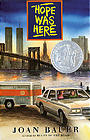
| Booktalk
#1
Sixteen-year-old Hope was raised
by her aunt. Hope is used to moving often and writes the message
“Hope was here” at each place she must leave just before she goes, a quiet
little statement of graffiti self assertion. Aunt Addie works as
a waitress. Addie starts a new job as a waitress and cook for Welcome
Stairways Diner in rural Wisconsin, where the owner, G. T. Stoop, has just
entered the local mayoral race. Hope volunteers to help with G. T.‘s
campaign. They discover that the current mayor is taking bribes.
Can a handful of honest people really make a difference in a corrupt government?
Will Hope need to write her little epitaph once again, and move on one
more time? (Jean Bellavance bellavance@erols.com
for Pennsylvania
Young Reader's Choice Awards, 2003)
Booktalk #2
What’s in a name? Perhaps
not a whole bunch to a lot of people. It means a lot to Hope
Yancey, who legally changed her name to Hope when she was twelve.
At fourteen she was a waitress, like the mother who left her to be raised
by her Aunt Addie. Addie is a great cook but because of her jobs
they move around constantly, most recently from Brooklyn to Mulhoney, Wisconsin.
There they live above the Welcome Stairways diner, across the hall from
its proprietor, G.T. Stoop, who is fighting leukemia and a shady mayor,
simultaneously.
What’s in a place? Where you live may not mean much to a lot of people;
but if you are sixteen-year-old Hope Yancey, you hate leaving the places
that you love, even if you consider yourself to be pretty adaptable.
As Hope begins to bond with the diner staff and customers at Welcome Stairways
she wonders if this will be just another stop along the road. She
tries hard to live up to all the meanings that Roget’s thesaurus gives
her name; and she finds herself alternately needing and giving hope.
Read Hope Was Here, by Joan Bauer.
“But when you’re in food service, you understand that sometimes you’re
making up for people in your customers’ lives who haven’t been too nice.
A lonely old woman at the counter just lights up when I smile at her; a
tired mother with a screaming baby squeezes my hand when I clean up the
mess her other child spilled.
You know what I like most about waitressing? When I’m doing it, I’m
not thinking that much about myself. I’m thinking about other people.
I’m learning again and again what it takes to make a difference in people’s
lives.” (Gail King, grking@bellsouth.net,
USC
- CLIS)
Booktalk #3
“Hope was here” is what sixteen-year-old
Hope writes when it’s time to move. She’s leaving Brooklyn this time where
she helped her Aunt Addie waitress at the Blue Box Diner. Now Addie and
Hope are moving to Mulhoney, Wisconsin, land of cheese. Goodbye sushi,
goodbye dim sum, goodbye city people.
The Blue Box Diner closed up
when the Addie’s partner stole the money and left town. Addie is a legendary
diner cook and was offered a job at the Welcome Stairways Diner. As soon
as they hit town, they meet the owner of the diner, G.T. Stoop, whom we
soon find out is fighting cancer, running for mayor against the incumbent
and operating his diner.
Addie loses no time reworking
the menu…no boxed potatoes will do for mashed! They must be whipped. And
the desserts? It won’t take long for Mulhoney to line up for Aunt Addie’s
apple pie. Hope is ever the fast talking, fast serving waitress. She’s
decided the Welcome Stairways Diner might be all right. Braverman, the
short order cook, gets a 6.4 out of 10 on the good looking-guys scale.
Maybe even a 7.2.
At the same time, we find out
that the Real Fresh Dairy took over all of the dairies in town and put
them out of business. Furthermore, the Real Fresh Dairy is not so fresh,
and hasn’t past all of the health inspections, and somehow, the current
mayor Eli Millstone hasn’t let that information out. Is the Real Fresh
Dairy a contributor to Millstone’s political campaign?
I found this a thoroughly entertaining
book and Hope is funny, strong and vulnerable all at the same time.
(Melissa Bowman, Melissa.Bowman@pisd.edu, Armstrong Middle School) |